What We Actually Do: Inside The Strong Side

A club can sell out every seat and still lose a sponsor in a week — because trust breaks faster than it builds. That’s the story behind the numbers below, and it’s the story The Strong Side exists to protect. Soccer is one of the fastest-growing categories in global sport. In the US, MLS’s 30 franchises are now valued at a combined $23 billion, up from $2 billion in league revenue, and the league opened its 2026 season with 75,673 fans — the largest opening-day crowd in its history (Sportico/RealGM, 2026; Football Business Journal, 2026). Globally, women’s elite sports revenue has grown 340% since 2022, on track for $3 billion in 2026, with $911 million in projected matchday revenue alone — fans are showing up in person, not just watching from home (Deloitte Global, April 2026). Off the field, the number of US bars dedicated to women’s sports quadrupled in 2025, from 6 to roughly 24 (NBC News, March 2025).
Every part of this growth is a bet on trust: that the people inside the game, on the field and around it, are being looked after. That trust is already being tested. Women’s World Cup players are 29% more likely to be targeted with abusive or discriminatory messages than men’s World Cup players (FIFA & FIFPRO, 2023 Tournament Analysis). The gap runs deeper than online abuse: 21% of women report childhood sexual abuse in sport, compared to 11% of men — and only 7% of women who experience it ever disclose (UNESCO & World Players Association). These aren’t isolated numbers; they’re industry-wide gaps in prevention and reporting, present at every level of the game.
When trust breaks, sponsors move fast — and it’s not a one-off risk, it’s a recurring one. In 2022, investigations into institutional abuse in the NWSL led Alaska Airlines, KeyBank, and Tillamook to pull or redirect sponsorship within days. The same year, investigations into Hockey Canada’s men’s program cost the federation funding from Tim Hortons, Scotiabank, Canadian Tire, Telus, and Nike — several pulled out permanently. The pattern held in 2025: homophobic chanting at San Diego FC’s inaugural home match, heard three times in front of 34,506 fans, forced the club to respond publicly the same night. Protecting trust is how a club protects ticket sales, memberships, and sponsorship revenue.
The Strong Side exists to protect that trust at the point where it’s most exposed: the moment something starts to go wrong, before it escalates.
What we actually do
The Strong Side runs on two tracks:
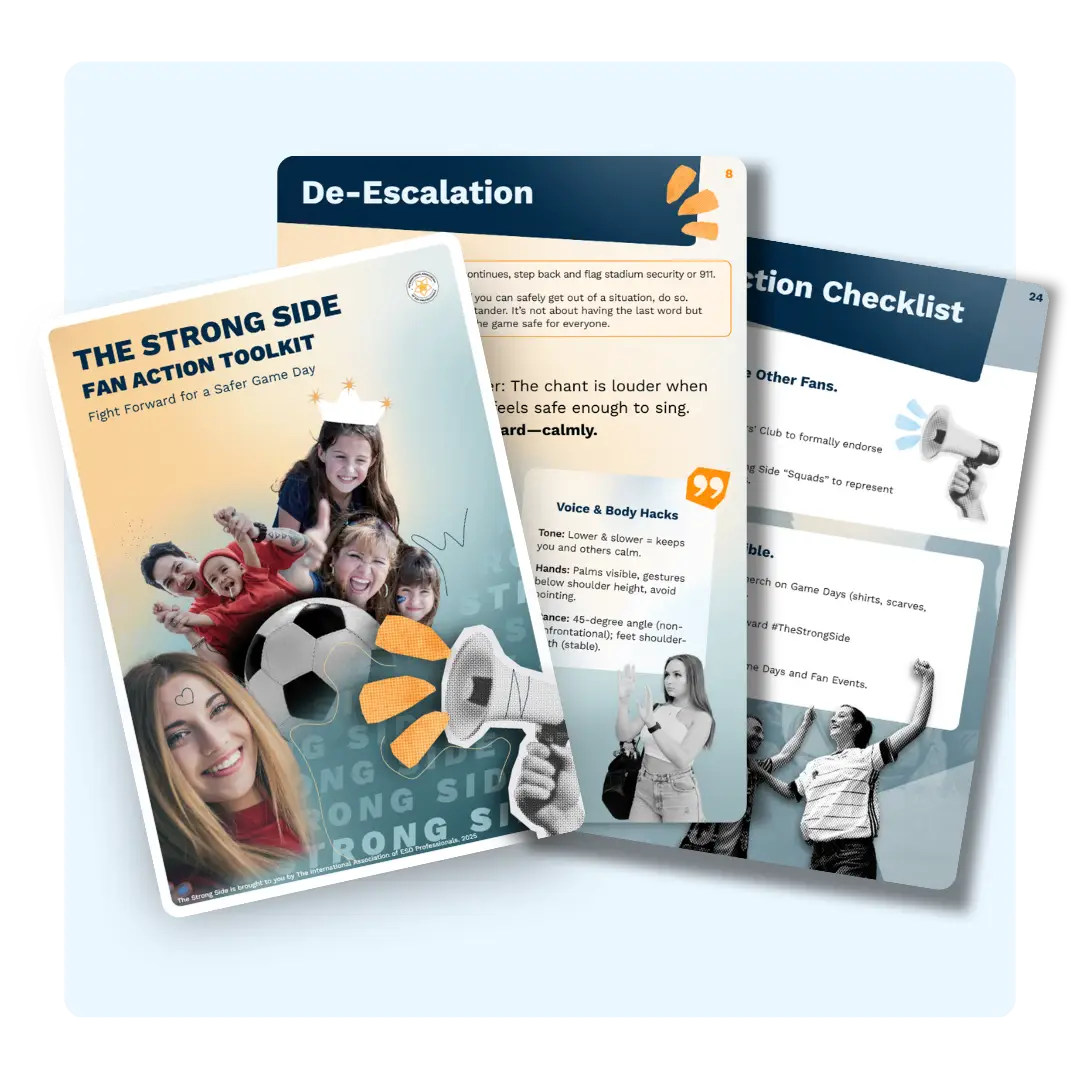
The fan-facing track trains people — regardless of gender — on Empowerment Self Defense (ESD) methodology: recognizing the early verbal, physical, and situational cues of an unsafe moment, setting a clear boundary, and using safe verbal de-escalation to intervene before a situation turns physical. Sessions run in gender-specific or gender-inclusive formats, chosen by the club or the participants. This track reaches fans, ushers, and any staff working directly with crowds.
The institutional safeguarding track is about building the kind of culture where people know what to do — and feel safe doing it — when something is wrong. It trains athletes, coaches, and staff to recognize and report workplace misconduct, backed by clear reporting channels. Safety is a workplace issue for the people who make the game happen, not only a fan-experience issue.
How we build trust
Every session runs on one operating principle: we look out for each other. The skill is simple to describe and rare to find trained — read a situation, recognize when someone needs help, and know exactly what to do next.
The Strong Side’s curriculum and impact measurement are grounded in a research collaboration with SEE Change at the Johns Hopkins Bloomberg School of Public Health, announced in June 2026, applying that same academic rigor to what actually gets taught in a stadium concourse or a locker room.
Why this matters now
The tools to close these gaps already exist and work at any scale — a single fan, a single team, or an entire league. The Strong Side already has partners moving on this.
Underdog Venture Team is bringing the program to market with professional clubs, handling outreach and onboarding so teams can add fan-facing and safeguarding training without building a delivery system from scratch. For clubs, that means a faster path from interest to trained staff and fans.
Wisdom for Women joined in June 2026 as regional provider partner for Australia and Oceania. The partnership gives The Strong Side a local delivery team in a region it couldn’t previously reach on its own, opening the door to pilots with clubs and leagues across Australia and the Pacific.
The growth story above is real. Protecting it is the next chapter.